Women who worked at NASA served as the brains behind one of the greatest operations in history: the launch of astronaut John Glenn into orbit, a stunning achievement that restored the Nation’s confidence, turned the Space Race to the United States’ favor, and galvanized the world.
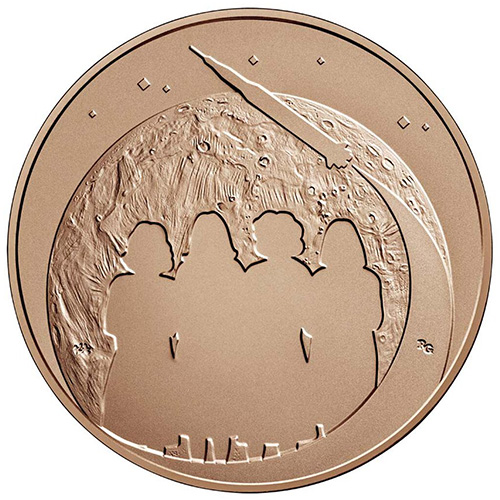
The obverse depicts a group of women in silhouette looking on as the Apollo 11 successfully puts the first men on the Moon. The figures are symbolic of the “hidden” nature of the many women, including those of color, who served as mathematicians and engineers, making significant contributions to the success of the space program while working for the National Advisory Committee for Aeronautics (later reformulated into NASA) from the 1930s to 1970s. By placing the women in silhouette, they appropriately represent any and all of the women to be honored by this medal.
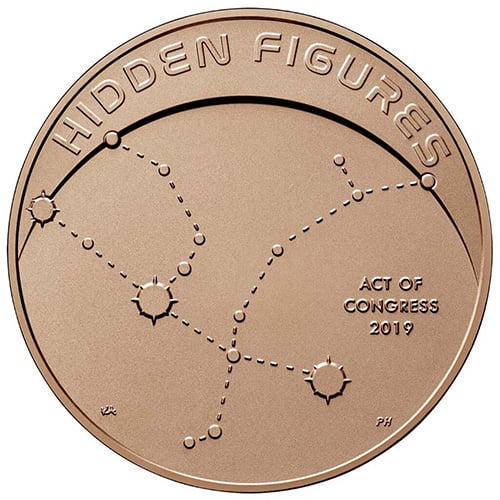
The reverse features the constellation Andromeda as a nod to the significant space program and aeronautics contributions made by the women being honored. Andromeda is also known as “the Chained Woman,” which is symbolic of the obstacles and difficulties overcome by the women whose contributions are finally being recognized and celebrated – breaking the chains of gender and racial constraints. The inscriptions are “HIDDEN FIGURES” and “ACT OF CONGRESS 2019.”
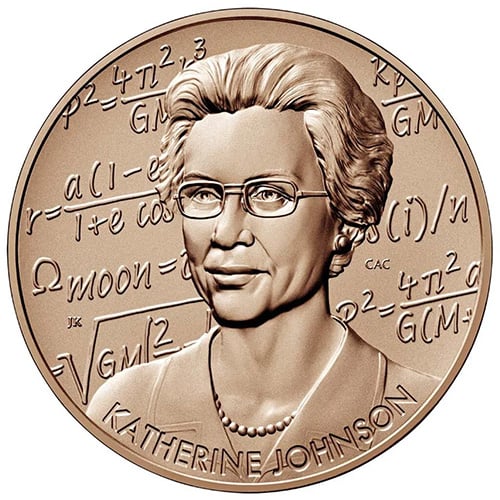
Katherine Johnson was an American mathematician whose calculations of orbital mechanics as a NASA employee were critical to the success of the first and subsequent American-crewed spaceflights.
The obverse depicts a portrait of Katherine Johnson in front of a variety of equations used to calculate the orbits and trajectories of spacecraft. The inscription is “KATHERINE JOHNSON.”
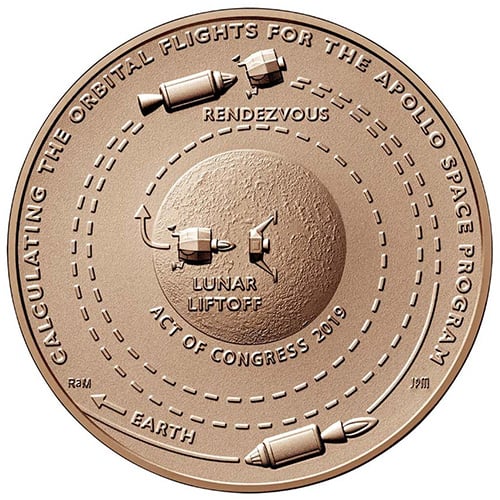
The reverse depicts a diagram on a chalkboard showing Apollo 11’s lunar lander linking up with the command and service module. The inscriptions are “CALCULATING THE ORBITAL FLIGHTS FOR THE APOLLO SPACE PROGRAM,” “RENDEZVOUS,” “LUNAR LIFTOFF,” “ACT OF CONGRESS 2019,” AND “EARTH.”
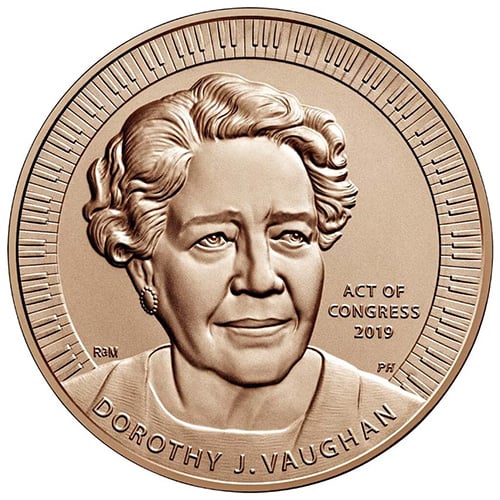
Dorothy J. Vaughan was an American mathematician and human computer who worked for the National Advisory Committee for Aeronautics and NASA at Langley Research Center in Hampton, Virginia.
The obverse depicts a portrait of Dorothy J. Vaughan. A border of piano keys encircles the design, representing her lifelong love of playing piano. Inscriptions are “ACT OF CONGRESS 2019” and “DOROTHY J. VAUGHAN.”
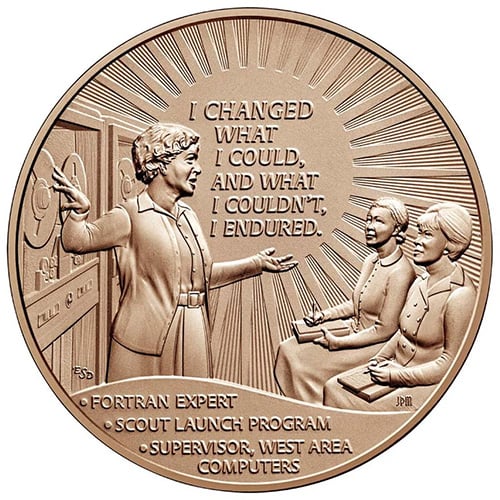
The reverse depicts Dorothy J. Vaughan in front of a mainframe computer in a teaching pose, instructing two colleagues. In the background, a sun symbolizes enlightenment, suggesting she was a beacon for others, leading the way for African American women. Inscribed in the center of the sun are Vaughan’s compelling words, “I CHANGED WHAT I COULD, AND WHAT I COULDN’T, I ENDURED.” Additional inscriptions are “FORTRAN EXPERT,” “SCOUT LAUNCH PROGRAM,” and “SUPERVISOR, WEST AREA COMPUTERS.”
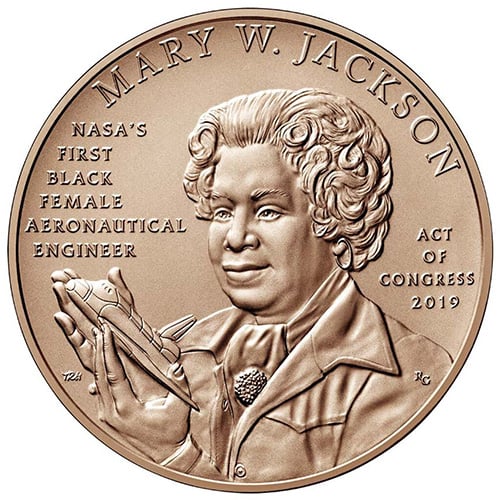
Mary Winston Jackson was an African American mathematician and aerospace engineer. She became the first Black female engineer at NASA, where she excelled academically during a time of racial segregation.
The obverse depicts Mary W. Jackson holding an early model of the space shuttle. Inscriptions are “MARY W. JACKSON,” “NASA’S FIRST BLACK FEMALE AERONAUTICAL ENGINEER,” and “ACT OF CONGRESS 2019.”
The reverse features a full-length figure of Mary W. Jackson holding a clipboard and pen, superimposed on a large wind tunnel, representing her work with air boundary layer information. The inscriptions “AERONAUTICAL ENGINEER,” “HUMANITARIAN,” “MATHEMATICIAN,” and “EDUCATOR” encircle the design.
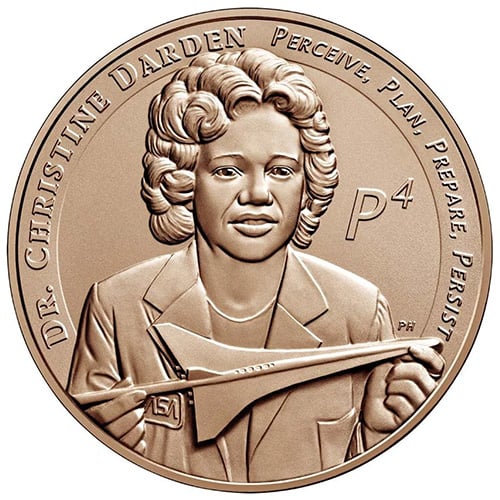
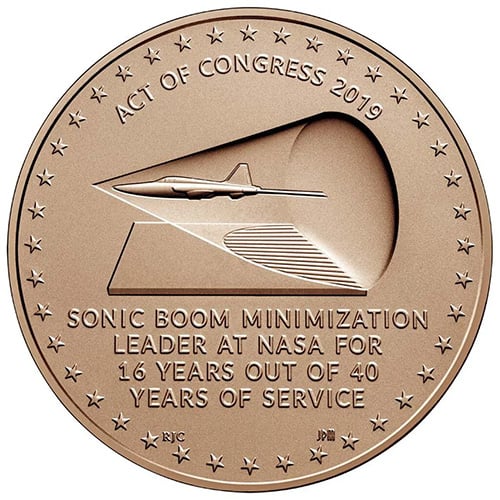
Dr. Christine Darden is an American mathematician, data analyst, and aeronautical engineer who devoted much of her 40-year career in aerodynamics at NASA to researching supersonic flight and sonic booms.
The obverse depicts a portrait of Dr. Darden holding a model plane. Inscriptions are “DR. CHRISTINE DARDEN,” “PERCEIVE, PLAN, PREPARE, PERSIST,” and “P4.”
The reverse design highlights Dr. Darden’s illustrious career. The stars symbolize her four decades of service at NASA, while the graph shows a sonic boom cone hitting the ground, explaining in visual form some of the mathematical formulas that describe the air pressures involved in sonic boom minimization. Inscriptions are “ACT OF CONGRESS 2019” and “SONIC BOOM MINIMIZATION LEADER AT NASA FOR 16 YEARS OUT OF 40 YEARS OF SERVICE.”
Background
The title “Hidden Figures” is a direct reference to the book by Margot Lee Shetterly and the film released in 2016 with the same name, and it has a double meaning. It refers to the mathematical calculations that went into the work at the National Advisory Committee for Aeronautics (which became NASA), but also to the women who worked behind the scenes performing these calculations.
Between the 1930s and 1970s, women worked as computers, mathematicians, and engineers at the National Advisory Committee for Aeronautics and NASA. These women played an integral role in projects such as aircraft testing during World War II; supersonic flight research; sending the Voyager probes to explore the solar system; and landing the first man on the Moon.
They also served as the brains behind one of the greatest operations in history: the launch of astronaut John Glenn into orbit. This stunning achievement turned the Space Race to the United States’ favor and restored the nation’s confidence.
Katherine Johnson, Dorothy Vaughan, Mary Jackson, and Dr. Christine Darden worked at the Langley Research Center in Hampton, Virginia. They were mathematicians and engineers who were central to the success of many of NASA’s missions.

 Celebrating America's 250th Anniversary