
 Countdown to America's 250th Anniversary
 Die Making at the U.S. Mint
The artistic designs on U.S. Mint coins and medals aren’t etched into each coin – they’re pressed. To press a design onto coins and medals, the Mint needs a stamp called a die. To make a die, the Mint uses another stamp called a hub.
Once the Secretary of the Treasury approves a design, U.S. Mint medallic artists turn the line drawing into a sculpted piece of art using clay, plaster, or digital software.
A machine engraves the design onto a steel hub, which shows the positive image the way the artist created it. The Mint transfers the image between several generations of hubs and dies in order to create the working dies that actually strike the coins.
STEP ONE:
Die Blanks
To prepare pieces of steel to become dies, a machine cuts steel rods into three-inch sections. Another machine forms one end into a cone, which is then polished to produce a smooth and shiny surface. The cone-shaped object is called a die blank.
The Mint uses steel for dies because it is strong enough to withstand being forced against other metals in the coin press.
 Hub with positive image and die with negative image.
STEP TWO:
Master Hub & Die
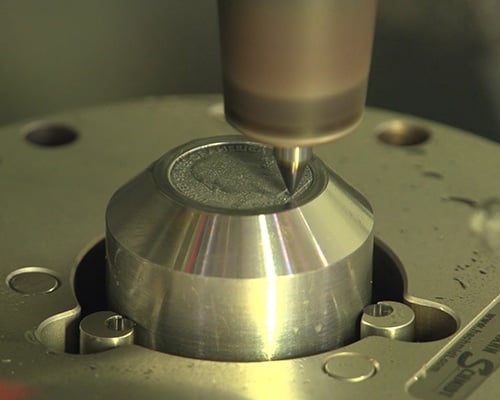
The first generation of a die is called the master hub. A computer numerically controlled (CNC) milling machine engraves the design onto the master hub. The Mint makes a master hub for each facility that will make the coin or medal since it’s at this stage that the machine adds the mint mark.
STEP THREE:
Working Dies
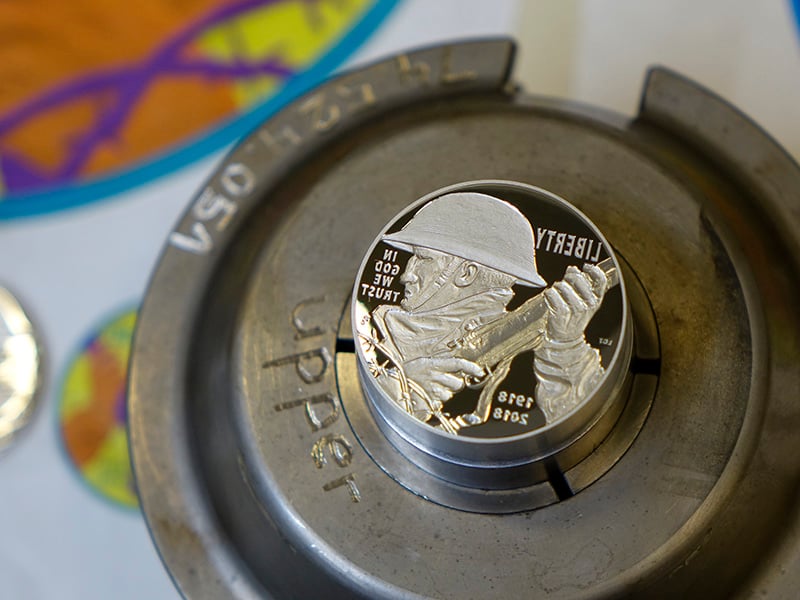
The master dies make working hubs. Working hubs then make the working dies that actually strike the coins. This multi-generational process is important to preserve the integrity of the master hubs and dies.
As the working dies wear out during coin production, the Mint uses the working hubs to make more working dies. Working dies and hubs get more use and wear out, while the lightly-used master hubs and dies stay preserved. A machine shapes the base and body of the working dies.
STEP FOUR:
Final Dies
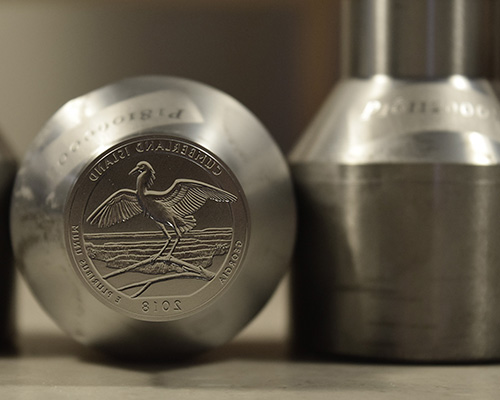
The working dies are heat treated to prepare them for the stresses of coin production. First, a furnace heats the dies to temperatures up to 1,800 degrees Fahrenheit. They’re quenched in liquid to lower the temperature. This treatment hardens the steel, but also makes it brittle and prone to cracking.
The dies are then placed in an oven to temper the metal. The dies go in the tempering oven twice, at temperatures up to 450 degrees. Tempering reduces the brittleness of the steel so that the die can strike hundreds of thousands of coins without breaking. The average life of a die varies based on the type of coin it strikes. The Mint uses penny dies to strike an average of one million pennies, but a dime die strikes only about 275,000 dimes.
Proof Dies
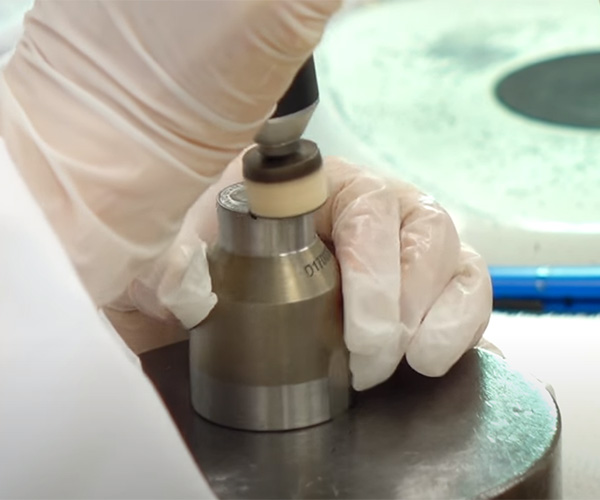
To make proof dies, Mint facilities use a combination of automated and hand finishing to prepare them, but may use slightly different procedures. At the San Francisco Mint, they start by applying tape to the areas that don’t need polishing, and the unprotected areas are covered with abrasive diamond paste.
The die goes into a machine that gives it an initial polish. An employee then further polishes the die under a microscope using rotary tools and diamond paste. To apply the frosted texture, a laser cuts tiny dents into certain areas of the design.
Written by Stephanie Meredith with help from the staff of the Denver and Philadelphia Mints, April 2021.